What Do Italians Eat For Breakfast In Florence?
The honest answer to what Florentines actually eat for breakfast: coffee and a cornetto at a bar counter, what it costs, and which tours include a proper pastry stop.
What Do Italians Eat For Breakfast In Florence?
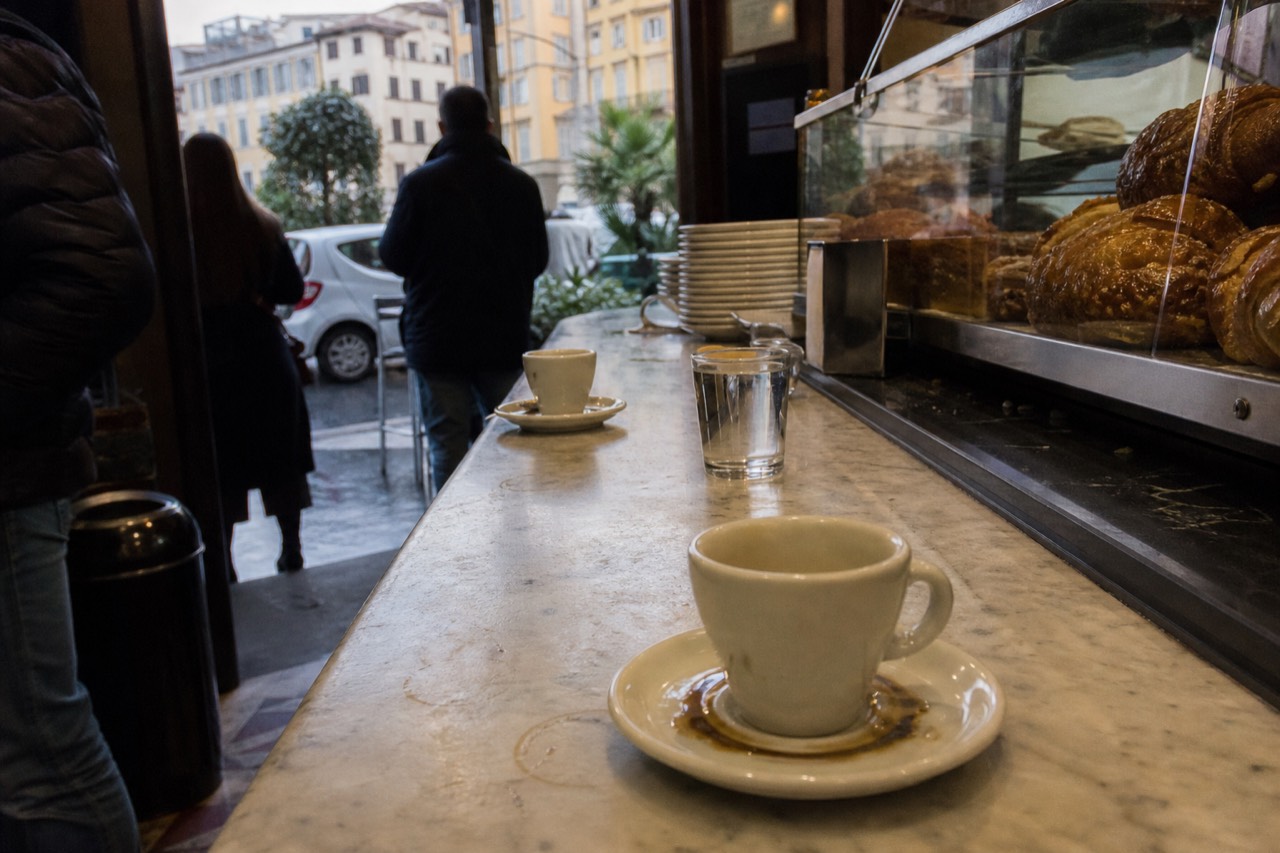
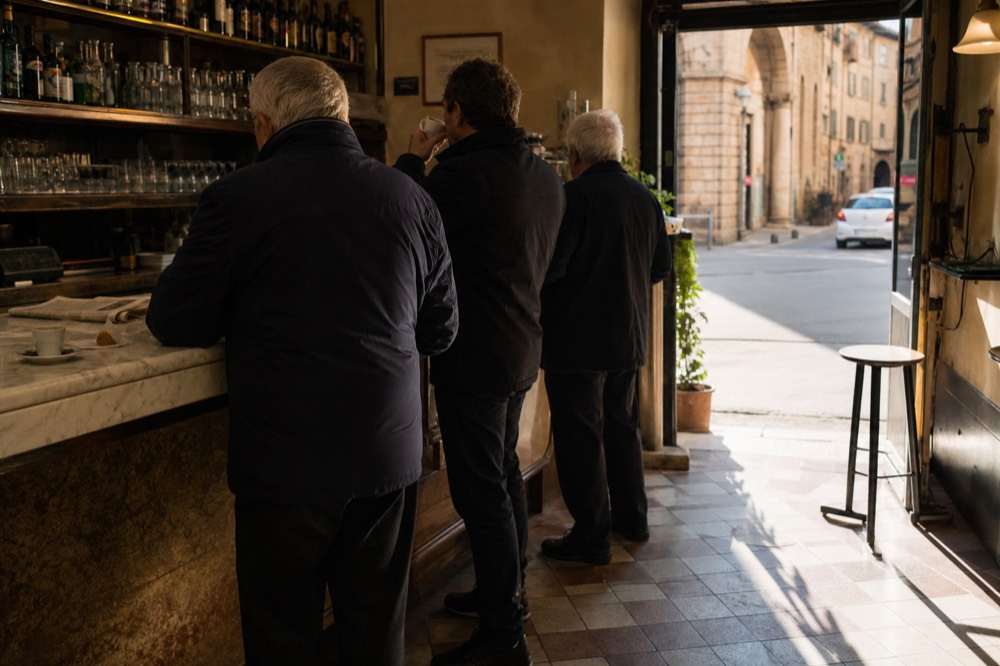
The standard Florentine breakfast is coffee plus something sweet, taken standing at a bar counter: an espresso or cappuccino with a cornetto, a sweet croissant-like pastry, sometimes a schiacciata alla fiorentina or a slice of cake. It is not eggs, not bacon, and not a sit-down meal, and most locals finish it in under ten minutes before work.
That is the whole habit in one sentence, and almost every detail of it surprises first-time visitors from North America. The bar in Italy is not a drinking establishment. It is a coffee shop with a counter, a coffee machine, a glass case of pastries, and usually a few tables that cost extra to use. You pay first at the till (the cassa), take your receipt to the counter, and say what you want. The Florentine day starts there, often before 8 a.m., with office workers, market porters and students cycling through in a steady stream that a visitor can join for the price of a coin.
What goes in the cup matters to locals more than visitors expect. Espresso is the default order, and cappuccino is the morning milky option. The old rule you will hear, that Italians never drink cappuccino after noon, has a real grain of practical logic behind it: milk is considered heavy, a breakfast thing, and a post-lunch espresso is the digestive. Nobody will police you if you order a cappuccino at 4 p.m., but it does read as a visitor's order, and the barista will make it without comment either way.
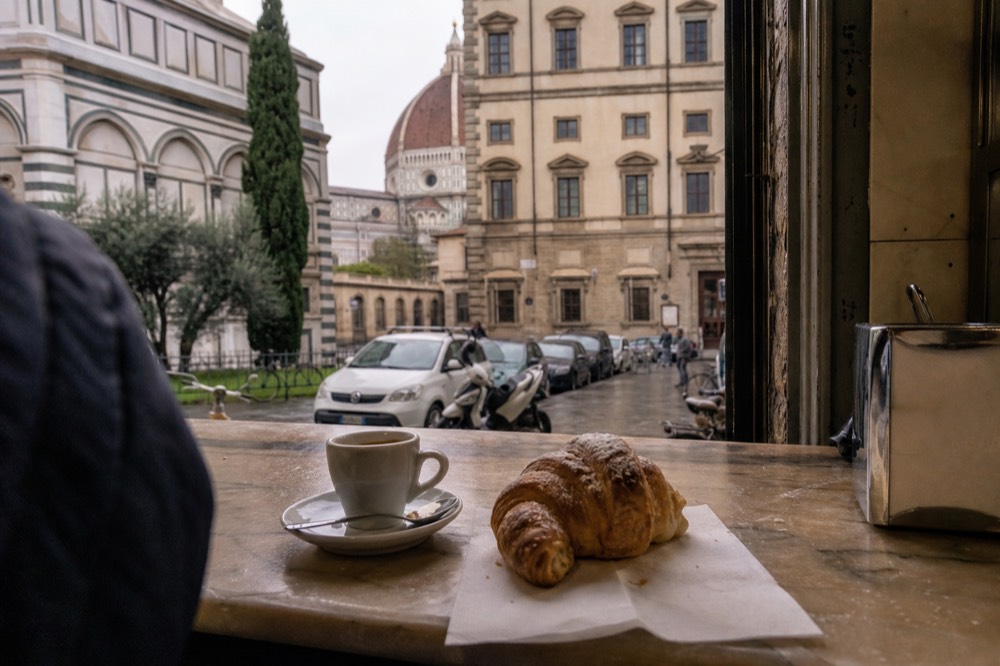
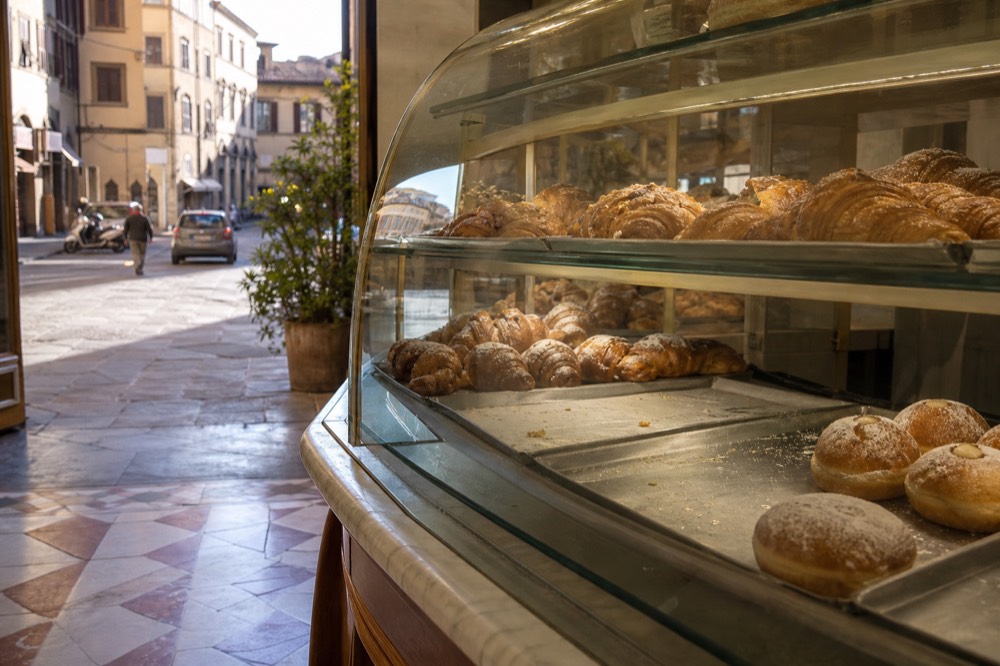
The sweet side of the counter is where Florence gets specific. The cornetto comes plain (vuoto), with apricot or cherry jam, with pastry cream (crema), or with chocolate. Alongside it you will usually find:
- Schiacciata alla fiorentina, the city's signature flat sweet bread, dusted with sugar and sometimes layered with cream or chocolate
- Bombolone, a filled doughnut, custard or chocolate
- Tortino di mele or frittelle di mele, apple cake and apple fritters, especially in autumn and winter
- Cantucci, the almond biscuits registered as Cantuccini Toscani IGP, though these belong more to end-of-meal dipping in Vin Santo than to breakfast
- Pane Toscano DOP, the saltless bread, which is protected and has a live PDO specification, but which locals eat at meals rather than breakfast
One genuinely fresh piece of the picture: Pasticceria Giorgio won the 2026 "Miglior schiacciata alla Fiorentina" contest on 17 February 2026, taking first place with 116 points out of more than 60 entries, ahead of Rimani and Ginella, according to Tasting Life. The contest is real, annual, and judged at the Scuola Cordon Bleu with support from the Comune di Firenze and Vetrina Toscana. A city that runs a competitive championship for its breakfast flatbread is telling you something about where its priorities sit, and the winning pasticcerie are ordinary neighbourhood shops, not hotel buffets.
If your own breakfast standards run higher than a counter pastry, or you want the sweet side of Florence explained rather than just sampled, the private coffee and sweets format exists exactly for this: it covers caffe, artisan chocolate, pastries and gelato in one two-hour private walk. You can Check availability on the operator's live listing to see the current dates and price.
How Much Does A Florentine Breakfast Cost?
A coffee and a cornetto in Florence averaged 3.10 euro by September 2025, according to La Nazione, with the espresso component running about 1.40 to 1.50 euro and the cornetto about 1.70 euro. A counter espresso in Florence averaged 1.26 euro and a cappuccino 1.49 euro on Fipe Confcommercio's reading of ISTAT 2025 prices, so budget 3 to 4 euro per person standing up.
Those are two different measurements and they should not be merged: the 3.10 euro figure is the combined coffee-plus-pastrino average from a consumer-association survey, while the 1.26 and 1.49 euro figures are the bar-counter prices from the trade body's data. Both are Florentine. The national picture is separate again: the Italian national average espresso stood at 1.29 euro in August 2026, up 24.2 percent since 2021, on MIMIT provincial data reported by Corriere della Sera. And the ingredient side has moved sharply: the price of toasted coffee in Tuscany rose 83 percent between December 2021 and December 2025, per Coldiretti Toscana's analysis of Istat and ministry data, with the average per kilo climbing from 7.41 euro to 13.56 euro. Never read a national figure as a Florence figure, and none of these numbers will be printed on the bar's wall.
What will surprise many visitors is the two-tier pricing at the same bar. Standing at the counter is the cheap way. Sitting at a table is a different product, lawfully priced higher, and the differential has to be on the price list before you order. One Florence bar owner made this explicit in September 2025, introducing a 1 euro table-service surcharge that took a seated espresso from 1.30 euro to 2.40 euro, as La Repubblica reported; the counter price stayed untouched, and the owner's stated aim was to discourage long table occupation at peak hours. There is no national law requiring bars to post counter and table prices side by side, a myth worth killing here, but the price list itself must be displayed where you can see it, and any servizio charge has to be on it before you order.
The practical arithmetic for a family matters. Two adults and two teenagers having cappuccino and cornetti at a counter pay roughly 12 to 14 euro for the four of them. The same order at tables, with the servizio, can approach 20 euro. Multiply by a week of mornings and the counter habit pays for a food tour, or at minimum a very good bottle of Chianti Classico, whose consortium history and rules are covered in depth by specialists elsewhere.
| What is actually eaten | What tourists expect | The reality |
|---|---|---|
| Espresso or cappuccino, standing | Large filter coffee, refills | Single small cup, no refills, drunk in a few sips |
| Cornetto, bombolone or schiacciata | Eggs, bacon, toast | Sweet pastry only, no savoury breakfast tradition |
| Paid at the cassa first | Table service | Receipt to the counter, order, often under 10 minutes |
| Counter price | One price anywhere | Table seating costs more, lawfully, if listed before you order |
| Nothing, for many locals on a rushed day | A full "Italian breakfast" | Plenty of Florentines manage on coffee alone |
Do Florentines Really Never Eat Eggs For Breakfast?
Correct, eggs are not part of the Italian breakfast tradition, and there is no verified standard Italian meal time, official or legal, that schedules breakfast at all. Hotel buffets serve eggs because international guests expect them, not because locals order them. The savoury breakfast you find in Florence is aimed at visitors, and the local version of a heartier morning is usually just a second pastry.
This is worth stating carefully because the internet is full of confident claims about "official Italian meal times". There are none. No primary source sets or publishes them. What exists instead is observable practice: bars fill between roughly 7:30 and 9:30 on weekdays, empty, then refill mid-morning with the second-coffee crowd. The record on this point is deliberately negative, and negative findings are the useful ones: they let you drop a common myth instead of repeating it. The same caution applies to claims about when Italians eat dinner or lunch: those are habits, not regulations, and habits vary by city, by job and by generation.
Two more myths can be retired in the same breath, since they all live at the bar counter. First, you cannot be fined for leaving a bar without your receipt: the business must issue a commercial document through its electronic till, but the customer is under no legal obligation to take or keep it. Second, the coperto, the cover charge you see on restaurant menus, is a different thing entirely from any bar charge, and in Tuscany it is lawful provided it is disclosed before you order; Lazio banned it, Tuscany did not, and a bar's table-service differential is not a coperto and not a tip. Knowing which charges are legal and which are invented is half of eating confidently in this city, and it is the kind of detail that rarely makes it onto a first page of search results.
The bread on the counter's savoury fringe is worth one paragraph of its own. Pane Toscano, the saltless bread, has been a registered PDO since 2016, and a standard amendment to its specification was approved on 28 July 2025 and published in the Official Journal on 12 August 2025, confirming the sourdough starter, the water and the specific soft-wheat flours from the defined Tuscan zone, per EUR-Lex. It is not a breakfast item, but it is the protected backbone of the Tuscan table, and visitors who taste it at breakfast-adjacent hours often meet it first on a food walk. If you want the full local bread-and-sweets landscape mapped out, our guide to Florence street food tours covers where schiacciata fits in the tasting day.
Which Tours Include A Coffee Or Pastry Stop In Florence?
The clearest match is the private coffee and sweets tour, a two-hour private walk built around caffe, artisan chocolate, pastries and gelato, rated 5.0 across 20 reviews and priced from $130.14. Beyond it, several street-food walks include a bakery or gelato stop, though coffee is rarely the focus; the Street Food Walking Tour with Wine pairs pasta, truffle, oils, charcuterie and wine with a bakery stop and gelato, from $63.00.
The honest framing is that most Florence food tours are built around lunch and dinner foods: pasta, lampredotto, cheese, charcuterie, steak, wine. Breakfast culture is a narrow slice of the roster, which is exactly why the private coffee and sweets option stands out. It is the only listing in the site's 22-tour roster whose entire premise is the sweet-and-coffee side of the city. Because it is private and two hours, it also works as a late-morning bridge between a hotel breakfast and lunch, rather than replacing a meal, and the private structure means the stops can be shaped around whatever your group cares about most, whether that is third-generation roasters or the chocolate workshops.
For travellers who want the pastry stop folded into a broader tasting walk, the cheaper street-food formats do it incidentally. The comparison below uses each listing's own stated inclusions.
| Tour | From price | Length | Coffee or pastry content |
|---|---|---|---|
| Private Coffee and Sweets Tour | $130.14 | 2 hours | The whole tour: caffe, chocolate, pastries, gelato, private |
| Florence Street Food Tour with Wine | $49.00 | 2.5 hours | Olive oil, balsamic and truffle tastings with local dishes, wine included |
| Florence City Highlights and Street Food Tour | $45.00 | 2.5 hours | Florentine recipe tastings on a sightseeing walk, cheapest on the roster |
| Florence Old City Street Food Tour | $51.00 | 2.5 hours | Cantucci with Vin Santo among six named tastings, plus gelato |
Prices and ratings can shift as operators update their listings, so treat the table as a planning map rather than a quote. The two budget walks both carry free cancellation up to 24 hours before start time, as does the private sweets tour, which makes a morning booking low-risk if your itinerary is still settling. The street food tour with wine runs 2.5 hours, which pairs neatly with a morning slot, so checking the live dates on the listing before you finalise the rest of the day is the sensible order of operations.
A note on timing your morning around a tour. Most walking food tours start late morning or early evening, because they are built around market and meal hours. If breakfast culture is the thing you actually want to understand, do it on your own at a bar first, then let a tour carry the rest of the day. Our Florence walking food tours guide breaks down the formats by time of day, and the question of what day is market day in Florence matters if you want your coffee near a working market rather than a tourist street. The site that publishes this article, Florence Food Tours, keeps the full roster of 22 verified tours in one place if you want to compare formats side by side.
How Do You Order Breakfast At A Florentine Bar Without Looking Like A Tourist?
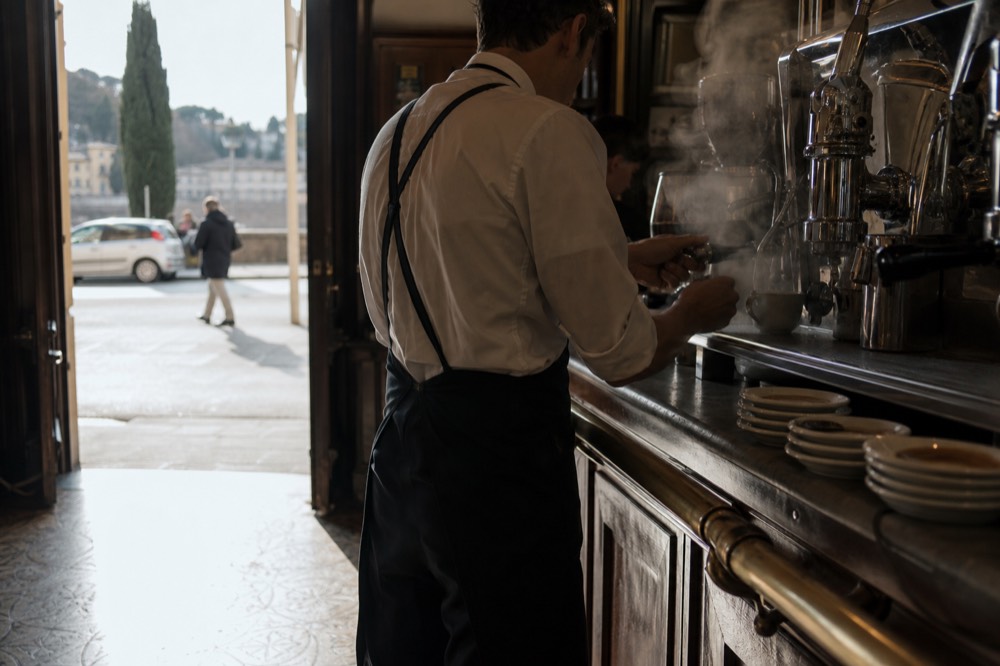
Pay at the till first, take the receipt to the counter, order by name, drink standing, and keep it to coffee plus one sweet thing. Say "un caffè" for espresso, "un cappuccino" until late morning, and point at the pastry case for the rest. Sitting at a table without asking is the single fastest way to pay double, and lingering for an hour over one coffee marks you faster than any accent.
The mechanics take one visit to learn. The cassa is usually at the back or the side. You say what you want, pay, get a scontrino, and carry it to the barista. In many bars you are technically expected to leave a small coin on the counter, though this is custom rather than obligation, and rounding up a few cents is the whole gesture. Tipping culture at the bar does not exist in the American sense: nobody expects a percentage, and a coin is generous. The barista will remember a regular within two or three mornings, which in a neighbourhood bar is worth more than any tip.
The order itself has a small vocabulary that repays learning:
- Un caffè means an espresso. If you want a long coffee, ask for un caffè americano.
- Un cappuccino is understood everywhere; the Florentine morning default after espresso.
- Un cornetto alla crema / alla marmellata / al cioccolato gets you the filled version.
- Una schiacciata in a pastry shop in winter means the Carnival-season flat sweet, not the salty focaccia of the same name, so context and the glass case settle it.
- Un caffè macchiato is espresso "stained" with a drop of milk, and un caffè latte ordered as "un latte" will get you a glass of milk.
The standing culture is not a performance of authenticity, it is the price mechanism. The bar charges the counter rate because you occupy no table. When the dehors rules that entered force on 11 February 2026 restrict outdoor seating on 60 streets in the UNESCO centre and cap total surface at its 15 November 2025 level, the tables that remain are scarcer and more explicitly priced, which pushes even more of the morning trade to the counter. The bar breakfast is not merely a habit, it is the format the city's regulation keeps encouraging.
If you would rather have the coffee, chocolate and pastry landscape explained by a local than decoded alone, this is the moment to check the live dates and price for the private sweets walk before your morning slots fill. The two-hour format leaves the rest of the day free, and the private structure means the stops can bend toward whichever of those pastries you loved at the counter. Either way, the counter habit itself costs almost nothing to learn, and it is the single cheapest piece of authentic Florence available to a visitor.
Breakfast in Florence means coffee and a sweet pastry at a bar counter, averaging about 3 euro, eaten standing in minutes rather than seated over a buffet. The questions below cover the costs, the myths and the ordering mechanics in one place.
Common Questions About Breakfast In Florence
What do Italians eat for breakfast in Florence?
Coffee and something sweet, standing at a bar counter: an espresso or cappuccino with a cornetto, bombolone or a slice of schiacciata alla fiorentina. It costs roughly 3 euro at the counter and takes minutes. Eggs and savoury breakfasts are hotel-buffet offerings for visitors, not local habit.
How much is a coffee and cornetto in Florence?
According to La Nazione, the average reached 3.10 euro by September 2025, with the espresso around 1.40 to 1.50 euro and the cornetto around 1.70 euro. Fipe Confcommercio data on ISTAT 2025 prices put the average counter espresso in Florence at 1.26 euro and a cappuccino at 1.49 euro. Sitting at a table costs more.
Is it true Italians never order cappuccino after lunch?
It is a convention, not a rule, and no law or official meal-time standard exists. Milk is seen as a morning food, so a lunchtime cappuccino reads as unusual, but bars will make it without comment.
Can I be fined for leaving a bar without my receipt?
No. The business must issue a receipt through its electronic till, but the customer is under no legal obligation to take or keep it. This is one of the most repeated Italy travel myths, and it does not survive contact with the actual rules.
Do bars have to post counter and table prices side by side?
No national law requires that. Charging more for table service is lawful provided the price list, including any servizio, is displayed and available before you order.
Which tour covers Florence breakfast culture?
The private coffee and sweets tour is the only one built around it: caffe, artisan chocolate, pastries and gelato over two private hours, from $130.14. Cheaper street-food walks include a bakery or gelato stop among broader tastings.